

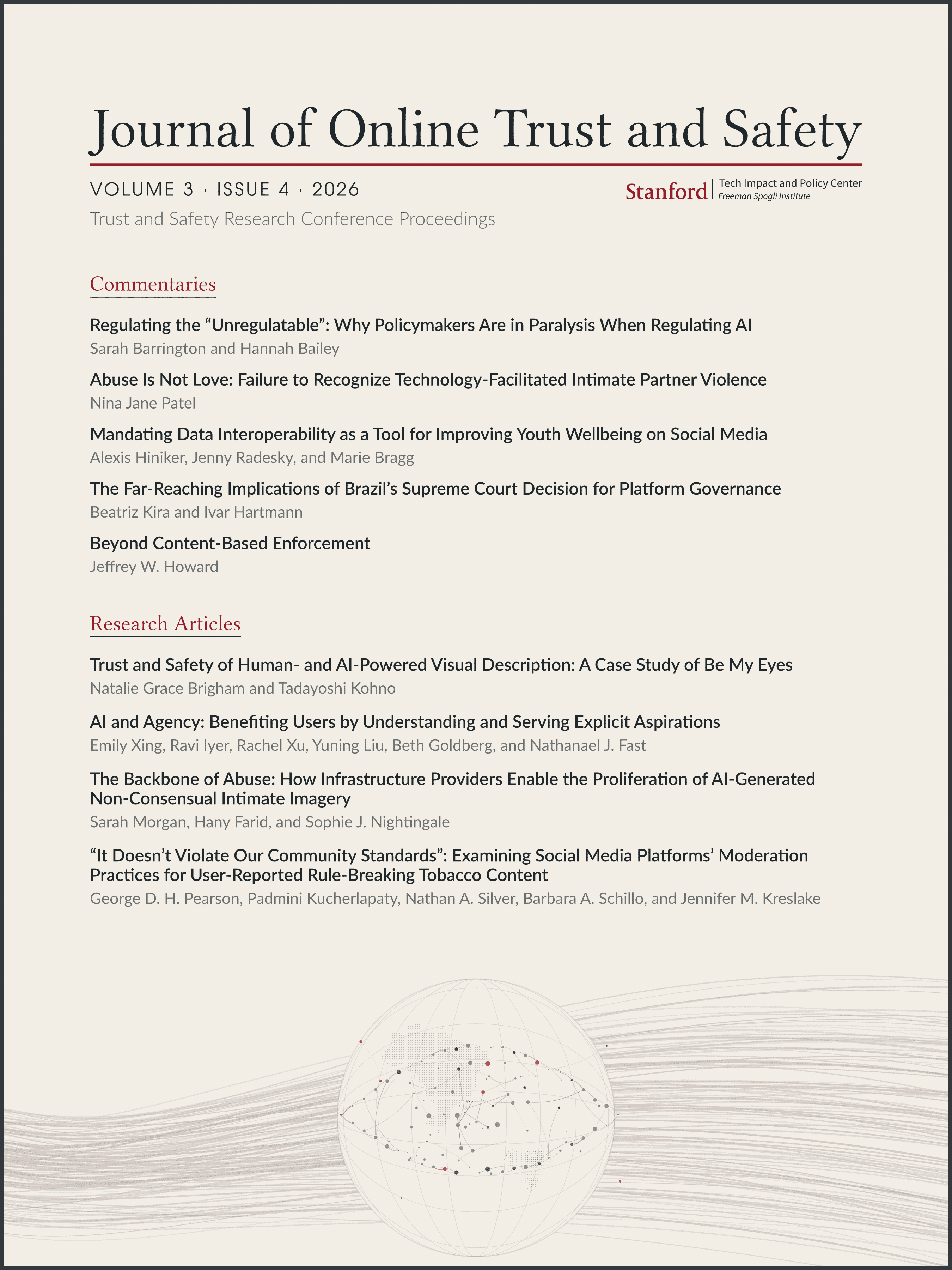
Current Issue
This special issue of the Journal of Online Trust and Safety, guest edited by Sujata Mukherjee, Mona Elswah, and Crystal Abidin, brings together eight peer-reviewed articles examining digital intersectionality and marginalization in the Majority World — the regions that account for the majority of the world's internet users but have been systematically underserved by existing trust and safety frameworks, scholarship, and infrastructure.
The eight papers are organized into three clusters. The first, on moderation systems and AI infrastructure, examines the foundational tools of platform safety from a Majority World perspective: Arora and colleagues analyze AI-generated deepfake abuse in Mexico and introduce the concept of "gendered digital creative violence," centering a feminist AI chatbot as a model of care-centered counter-infrastructure; Gamage and colleagues document how South Asian-language deepfake content persists on platforms after reporting while English-language equivalents are removed; and Mustafa and Wu audit multilingual AI safety benchmarks and find systematic gaps in coverage of low-resource languages. The second cluster, on platform governance, examines the institutional mechanisms through which platforms govern speech and harm: Chala's statistical analysis of 147 Meta Oversight Board decisions identifies structural advantages for English-language cases in procedural routing, while Pachouri and colleagues find that institutional trust — not technical design — drives adoption of Indonesia's national digital identity system. The third cluster, on gendered harm and queer safety, documents harms that fall through the gaps of existing infrastructure: Aljizawi and colleagues identify a protection gap in cybersecurity training for exiled queer women human rights defenders, arguing for a model of "queer cybersecurity" that begins with the person rather than the device; Hooman and Hodson examine how X's platform architecture amplifies queerphobic harassment targeting Iranian activists in diaspora; and Thakur analyzes GBV directed at Quechua women creators on social media platforms.
The editors are grateful to the Trust and Safety Foundation Research Coalition's Global Majority Research Committee for their institutional support of this special issue, and to our peer reviewers for their timely, contextually grounded, and constructive engagement with the manuscripts.
The Journal of Online Trust and Safety is grateful to the Omidyar Network for their generous support.